
Case Study: Waltham Forest Community Earth Circle & Sculptural Seating


Project Overview
- Location: Waltham Forest, E17, London, UK
- Collaborators: Smith & Newton Architects, sculptor Owen Bullet
- Photography: Neil Perry Photography
- Design Life: Circa 15 years
Project Description
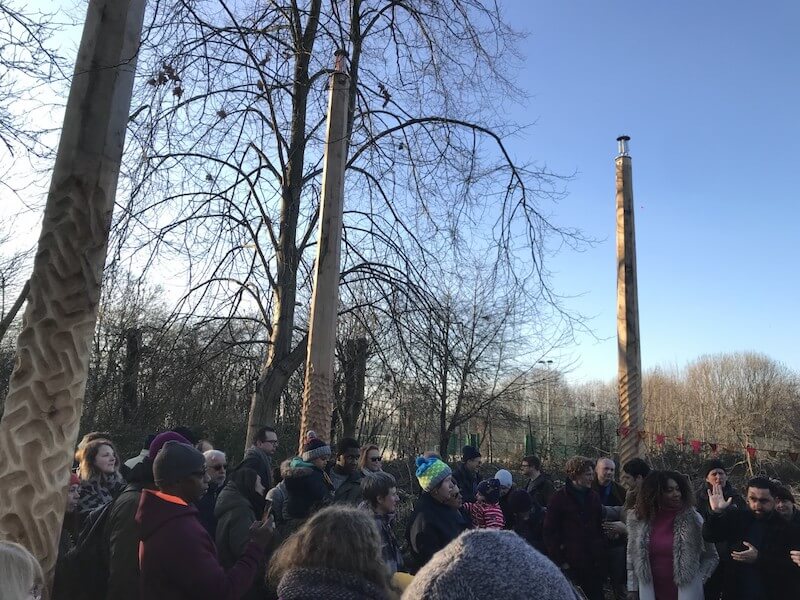
This collaborative community art and public realm project in the London Borough of Waltham Forest integrates landscape architecture, sculpture, and civil engineering. The focal point of the installation is a 6-meter-diameter earth circle framed by an arrangement of tall, tapered, carved wooden posts embedded directly into the subsoil. The perimeter is complemented by a series of roughly hewn wooden boulders that function as durable, natural seating elements for local passers-by, families, and visiting school playgroups.
Engineering Challenges & Geotechnical Constraints
1. Root Interference & Foundation Limitations
The primary engineering challenge stemmed from the dense concentration of mature tree roots populating the immediate installation zone. Conventional excavation and the introduction of mass concrete footings were ruled out early in the design phase to avoid root severance, which would have compromised the health and stability of the surrounding mature urban canopy.
2. Subsoil Conditions & Load Transfer
To overcome the absence of traditional concrete foundations, PSL Engineers conducted a comprehensive geotechnical assessment of the underlying ground conditions. The investigation confirmed a stable, firm clay stratum lying beneath the root zone.
Engineering Solution & Methodology
- Pre-Cored Subsoil Sockets: Rather than utilizing cast-in-situ concrete bases, the structural stabilization strategy relied on precision pre-cored vertical holes driven through the upper root matrix and keyed securely into the underlying firm clay subsoil.
- Direct Embedment & Uplift Resistance: The tall, tapered wooden posts and structural timber elements were socketed directly into these pre-cored clay formations. This technique successfully transferred lateral wind loads and gravity loads down to the competent clay layer while maintaining minimal physical disruption to the surrounding root network.
- Material Durability: Designed with an anticipated structural design life of approximately 15 years, the connection details and timber embedment depths were engineered to account for moisture variation within the clay and long-term environmental exposure.
Conclusion
Through close coordination between the structural engineers, architect Smith & Newton, and sculptor Owen Bullet, the Waltham Forest earth circle successfully balances artistic vision with rigorous arboricultural and geotechnical protection. The resulting installation provides an enduring, safe, and contextually sensitive community space without impacting local ecology.